



Equipment Roundup
AEM Safety Toolkit; CASE IH Maintenance Tips; New Holland Commemorative Tractor and C Series Compact Wheel Loaders
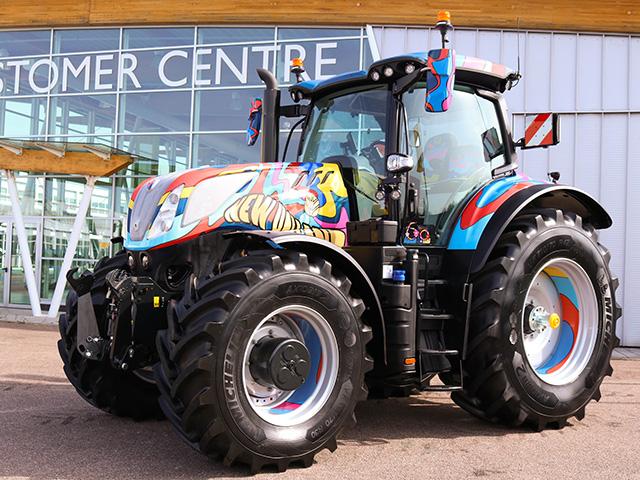
In this Equipment Roundup, DTN/Progressive Farmer looks at an online safety toolkit from the Association of Equipment Manufacturers, maintenance tips from Case IH, New Holland's commemorative T7.300 tractor and New Holland Construction's C series compact wheel loaders.
**
AEM SAFETY TOOLKIT
In a move to bolster safety across the off-highway equipment industries, the Association of Equipment Manufacturers (AEM) is introducing a free online safety toolkit tailored to promote safety awareness, education and training for operators of off-highway equipment used in the construction, agriculture, utility, mining and forestry sectors.
The toolkit covers a wide range of machinery. AEM members produce more than 55 types of off-road equipment.
"These are not operator's manuals. They are specifically related to safety," said Jaime Vos, AEM's senior director of cultural innovation. "These serve as best practices references. The manuals can be viewed online. You can assign them to workers in your organization or you can view them in a classroom."
The manuals highlight common safety hazards to each type of equipment, conditions such as pinch points, fuel hazards, electrical hazards, and much more. The toolkits also seek to make operators aware of personal hazards -- drowsiness, alcohol and drug use -- and their need to fully understand employer guidelines for the safe operation of machinery.
"There are common areas of awareness (among off-road equipment types). These are things like before you start (a piece of machinery), follow a safety program -- such as operating safety, maintenance safety, transportation safety. These are all common areas regardless of the equipment being used," said Vos.
AEM's Safety Toolkit delivers a comprehensive suite of resources aimed at enhancing safety awareness, education and training including:
-- Digital Safety Manuals: Insights into best practices. These references complement, but do not replace, original equipment manufacturers' (OEM) documentation or printed safety manuals which may be required for the machine.
-- Action Plans: Learning modules that guide users through on-site equipment operational best practices.
-- New Materials: Stay informed with the latest news, best practices and industry insights through AEM's repository of articles, updated regularly.
-- Training Resources: Enhance toolbox talks with downloadable training slides, educational materials and AEM's safety pictorial database, ensuring comprehensive safety coverage.
Vos says learning safety protocols are not just a "one and done" exercise. "Off-road equipment, ag equipment is advancing every single year," he said. "The technology is changing; the functionality is changing. There is computer automation, whether that is autonomy or alternative power sources, like batteries. There is something new to learn every single year."
P[L1] D[0x0] M[300x250] OOP[F] ADUNIT[] T[]
For more information of AEM safety materials: www.safetymaterials.org
EXTEND MACHINERY LIFE
A farm budget benefits from good machinery maintenance. Maintenance aimed at extending high performance is a key tactic to spend less in 2024.
"It's all about preventative maintenance," said Aaron Booth, manager of product marketing, Case IH Parts & Service. "When you do that routine maintenance, use OEM fluids and filters. These have been tested and validated in the field that hold up under the conditions our equipment is operating in, and it is what is going to extend the life of your equipment over time."
Good maintenance adds value to equipment. "If you're a farmer who isn't keeping equipment for more than three years, you also provide some assurances to that second owner that the equipment has been well maintained," Booth said.
Booth suggests these good maintenance practices:
-- Follow the maintenance recommendations of the manufacturer's operator's manual.
-- At least once a year, change engine oil and filters. Choose OEM fluids, filters and parts. Non-OEM-approved fluids can compromise machine performance, causing decreased efficiency and productivity and increasing cost of ownership.
-- Have a good relationship with the dealer. Consider enrolling in maintenance contracts. For example, Booth suggested considering Case IH Planned Maintenance Agreements when purchasing new equipment to ensure you follow recommended service intervals. Maintenance contracts also lock in costs at the time of purchase.
-- Prioritize routine maintenance. Make greasing a priority. Regular inspections and worn part replacement can help prevent bigger issues with downtime and expenses. Do a quick walkaround to look for leaks and pieces that are out of place.
-- Develop a checklist for routine inspections of hoses and fittings, looking for wear, cracks and leaks.
-- Act on error codes. Don't ignore them and push on through. Contact the dealer for analysis of error codes.
-- Keep a written list of potential maintenance and repair items that, while they didn't cause breakdowns during the season, they are items that can be repaired in the off-season.
-- Store equipment indoors or undercover to prevent sun damage, tire cracking or premature rust
NEW HOLLAND T7.300 TRACTOR
New Holland celebrated 60 years of manufacturing at its tractor factory in Basildon, England, with the unveiling of a special edition tractor, the T7.300 tractor.
The tractor's distinctive graphics are inspired from the 1960s which saw New Holland making leaps forward in its new tractor technologies, New Holland says in a release. The Basildon facility was opened in February 1964.
Created by CNH Centro Stile, the anniversary edition's ornamentation is inspired by the colors and patterns of "Swinging '60s" London with psychedelic shapes characterized by vivid and fluid colors of blue, yellow, maroon and pink around New Holland's distinctive leaf logo in bright yellow on the hood.
The tractor, of which only one unit will be produced, was unveiled at the Basildon 60th anniversary celebratory event on April 9 and then will be showcased at exhibitions throughout 2024.
The Basildon plant also is home to the New Holland Alternative Fuels Centre of Excellence. In 2006, New Holland declared its ambition to be the "Clean Energy Leader" in the tractor sector, and in 2021 put into production at Basildon the industry's first tractor of its type, the T6.180 Methane Power LNG. It will be joined this year by the T7.270 Methane Power CNG.
These are developments that make possible the New Holland-named Energy Independent Farm, allowing biomethane captured from waste farming products, such as livestock manures, to be used as fuel.
"Today Basildon is a hub for innovation where we produce tractors that are exported worldwide and a Centre of Excellence for Alternative Fuels, where our T6.180 Methane Power tractor is produced," according to Carlo Lambro, New Holland brand president, said in the New Holland release. "As the only volume tractor producer in the UK, we are also very proud of our workforce here with their skills, dedication and commitment. It's a milestone for the whole company and for everyone who works or has worked in the plant."
NEW HOLLAND CONSTRUCTION ADDS NEW LOADERS
New Holland is adding three advanced C series compact wheel loaders to its line -- the W60C, W70C and the W80C LR, the last designed for agricultural work.
-- The W60C features upgrades to horsepower and the Z-Bar boom design gives it applications such as landscaping, material handling and snow removal.
-- The W70C takes on the same jobs as the W60C but with more horsepower (74 hp), speed and performance. It has a lighter operating weight of 12,000 pounds.
-- Designed for the agricultural market, the W80C LR is a high-speed option (25 mph) that employs a lift capacity of 10,600 pounds and an operating weight of 13,000 pounds. The W80C LR is optimized for tasks like loading feed or stacking bales.
The W60C, W70C and W80C LR models are available for order through North America New Holland Construction dealerships.
Dan Miller can be reached at dan.miller@dtn.com.
Follow him on social platform X @DMillerPF.
(c) Copyright 2024 DTN, LLC. All rights reserved.